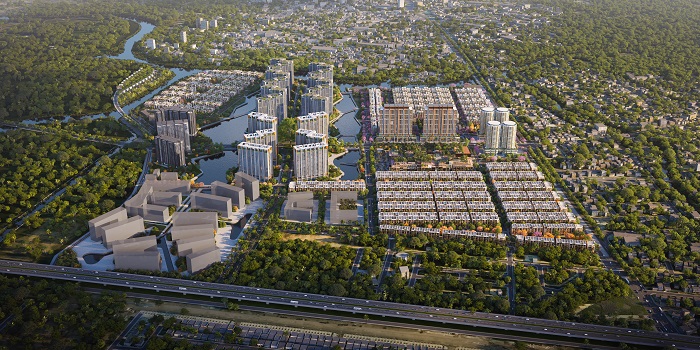
Two metro lines connecting Ho Chi Minh City and Binh Duong (formerly) have been proposed for investment by the Becamex – THACO consortium with a total capital of over 124,000 billion VND. The project is expected to commence in 2027 and be operational from 2030.
The consortium of the Industrial Development Investment Corporation (Becamex IDC) and Truong Hai Group Joint Stock Company (THACO) recently submitted a proposal to the Ho Chi Minh City People’s Committee to study the investment in Metro Line 1 (Binh Duong New City – Suoi Tien section) and Metro Line 2 (Thu Dau Mot – Ho Chi Minh City section).
According to the proposal, the first metro line will connect from the center of Binh Duong New City (now Hoa Phu Ward, Ho Chi Minh City) to Suoi Tien Bus Station, with a total length of approximately 32.43 km. The line is expected to have 19 elevated stations and operate at a maximum design speed of up to 120 km/h.
With a total investment of approximately 64,370 billion VND, this metro line is considered a vital transportation artery, directly connecting to the existing Metro Line 1 (Ben Thanh – Suoi Tien). The project not only meets the demand for high-volume passenger transport but also ensures safety and energy efficiency.
Simultaneously, Metro Line 2, 24.2km long, will connect the Thu Dau Mot area to Hiep Binh station (part of Metro Line 3 of Ho Chi Minh City). This line is expected to have 14 elevated stations, with a total investment of approximately 59,968 billion VND, of which land acquisition costs account for over 15,000 billion VND.
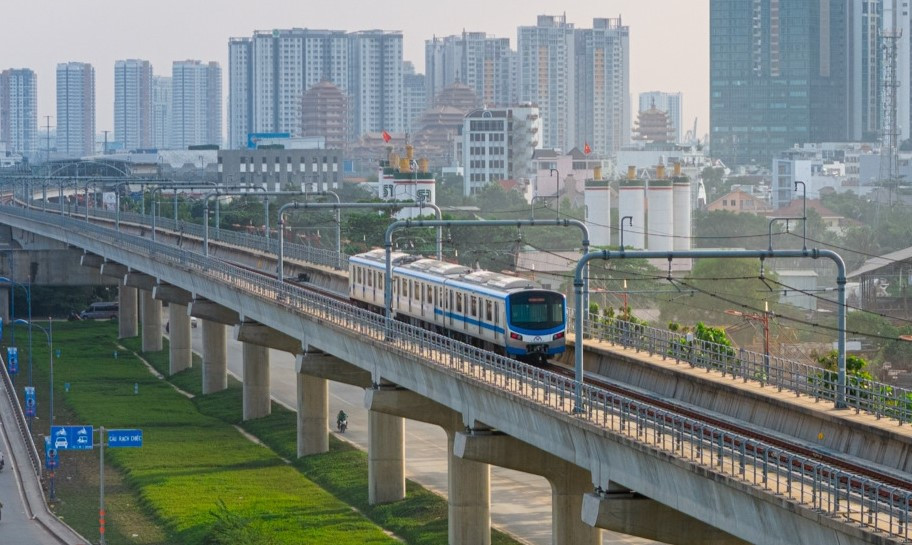
Both projects are being developed by the consortium of investors under the Transport-Oriented Development (TOD) model. The investment is expected to be implemented through a public-private partnership (PPP) model, such as BOT or BT, to maximize the mobilization of social resources and reduce pressure on the state budget.
To ensure feasibility, the Becamex – THACO consortium commits to fully cover all research costs and bear all risks if the application is not approved. If the Ho Chi Minh City People’s Committee approves the plan, the investors will expedite the completion of legal procedures in 2026, aiming for commencement in the first quarter of 2027 and striving to put the project into operation from 2030.
After the merger, the Ho Chi Minh City urban railway network is expected to comprise 27 lines with a total length of approximately 1,012 km. Of these, the former Binh Duong area has 12 lines totaling approximately 305km, while the former Ba Ria – Vung Tau area has 3 lines totaling approximately 125km. Based on new regulations, especially Resolution 188 of the National Assembly, Ho Chi Minh City is simultaneously implementing many metro projects.
Currently, Ho Chi Minh City has commenced construction on metro line 2 (Ben Thanh – Tham Luong), broken ground on the Ben Thanh – Can Gio railway line, and is preparing to start construction on the Ben Thanh – Thu Thiem section (part of metro line 2) and the Thu Thiem – Long Thanh railway line.
.png)